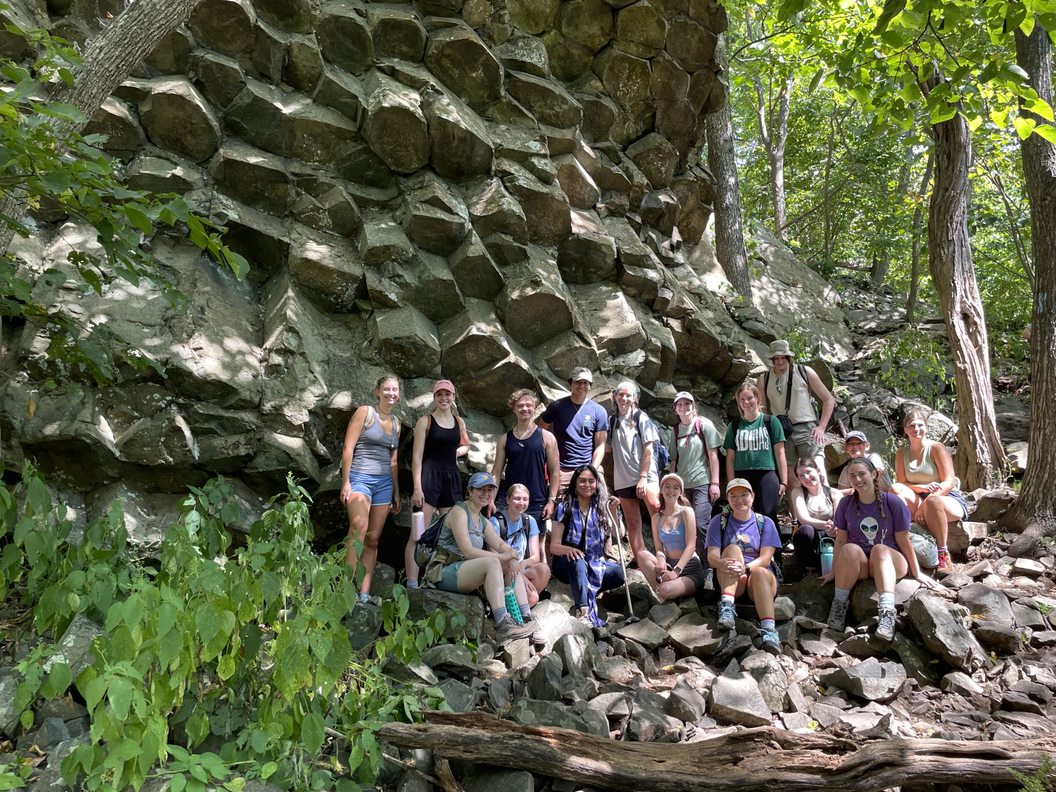

My four short months here have given me so much to be thankful for. The number of things I’ve learned, done, and people I’ve met in such a small amount of time is overwhelming – I jumped out of a plane, assisted with ultrasounds on Mongolian wild horses, gave an hour-long research presentation on tiger shark migration, and rolled, frolicked, and hiked all over the Shenandoah mountains. It is difficult for me to do justice in words to how unique and incredible this semester was.
Dolores Reed, my friend and mentor this semester, is the animal curator for the hoofstock program at SCBI. On our last day, she asked me two questions: what was the most valuable thing I had learned during my time at SMSC, and what was my favorite part. It took me some time to settle on an answer.
My biggest takeaway from my semester at SMSC is the sheer vastness of the interconnectivity within conservation. I mean that in many different facets. The interconnectivity of our global natural environment. The interconnectivity of our social environment; the interconnectivity of people and nature, and within the discipline of conservation itself. I often talk about this in my previous posts. The necessity of approaching ecological problems from as many viewpoints as possible. The necessity of considering unexpected alternatives, to cooperate with people from all walks of life to achieve success. That alone is the most valuable thing I have learned.
Granted, this was something I already knew and believed, but in practice it is a different thing altogether. To look at situations in which that was not done and how different results could be if we learn the art of collaboration. I love the challenge of playing “devil’s advocate”, as it humanizes and validates perspectives that differ from your beliefs, helping explore human psychology and creating opportunities to build bridges. I find this perception fascinating, and it offers such a singular outlook on how the world operates.
What I had not anticipated was how profound of an influence this experience would have on my world view. Being in the rural farmlands and mountains of Shenandoah, surrounded by a community of passionate and intelligent conservationists and environmentalists, I really gained a completely different perspective on society. Through this semester, my experiences helped me realize why I had such a difficult time finding a sense of place in highly urbanized northern Virginia: the overstimulation of consumerism and bombardment with endless distractions; ease of access to the things we want, but not always the things we need; the absence of tools to make environmentally friendly choices even if you wanted to; the wastefulness of resources; the inability to find quiet, solitude, something that isn’t carefully manicured and catered to human convenience.
Maybe it is just me, but the air feels so much cleaner, and I breathe so much easier, in the mountains of Shenandoah. Here, I found the first real sense of belonging, community, and peace, since leaving my little rock in the Caribbean almost four years ago.
But SMSC is a microcosm. Surrounded by my peers, people who make protecting our planet the top priority, I feel like I’ve fallen out of step with the fact that the rest of the world doesn’t think like us. I am preparing myself for the harsh reintroduction to the real world that will come with leaving our little home in Front Royal.
While that reality check is important, it is also important to remember – when the sheer weight of the biodiversity crisis stares you in the face – that this community does exist. It is important to remember that there is a group of incredibly driven individuals who continue to fight every day, and that it is a rapidly growing community. I am so eternally grateful to my professors, my classmates, and all the guest speakers this semester. The outpouring of support, encouragement, and hope are essential to someone entering a field with what often seems like few opportunities and few successes. In a field where the bad news gets more attention than the good news, focusing on the positive is so imperative.
That said, we were given so much more than words of encouragement – they gave us practical and applicable tools. They made success tangible. They made us a part of the community that achieves those successes. In the words of my friend and classmate Jamie: “When I came to SMSC I was a biology student. Now I feel like a scientist, like a real conservationist.” I no longer feel like the idealist tree-hugger that so many young conservation students are labeled as. I feel like a professional, like someone truly capable of enacting change.
It is with great excitement and sadness that I say goodbye to SMSC this week. I had been looking forward to this program since I was 15 years old, and it exceeded my expectations. It was what I needed academically and emotionally. It gave me back my motivation and inspiration. No other program like this exists in the U.S. I think any program anywhere would be hard-pressed to compete with the experiences SMSC offers. I know without a doubt that I will never forget the amazing people I have met here, or the genuine love and support from the entire community. It is invaluable.
So, in following the advice of our dear professor Jim McNeil, let’s go out on our adventures. Let’s take what we have learned and share it with the world. Let’s be veterinarians, psychologists, OneHealth practitioners, policy-makers, lab scientists, field researchers, and communicators – but remember no one is alone in their endeavors. Across SMSC, across the conservation field, across the country and the globe, we are all in this together.
One response to “Love Letter to SMSC – Saying Goodbye”
I’m so proud of all the work and dedication you put in. Can’t wait for the next chapter of posts!